what do science art and religion have in common
An influential modern meter reading of William Dyce's Pegwell Bay, Kent – a Recollection of October 5th 1858 ?1858–60 (Tate N01407) is that it is fundamentally nearly sentence, and that it represents the threat posed to traditional Christian feeling by the vastness of interstellar space and the long aeons of earth science meter. The artistic creation historian Marcia Pointon, in a short but persuasive article published in 1978, pointed out that Dyce's title referred to the day when Donati's comet was at its brightest, and notes that astronomy is Hera attended away geology, the two sciences described by the poet Alfred Tennyson as 'Terrible Muses':
It is, surely, no coincidence that Astronomy, represented by the comet, is accompanied in Dyce's picture by her sister Muse, Geology, apparent in the crystalline clarity of the chalk drop-off and the carapace-strewn beach.1
In the mid-nineteenth century, new discoveries, especially in geology, were significative the great age of the solid ground and the existence of dinosaurs, challenging the traditional Christian belief that the world had been created in six years in 4004 BC. Many Christians, including Tennyson and the art critic John Ruskin, were troubled by the new sciences. Pointon implies that Dyce was too:
The artist's relatives are seen in microscopic point, strung out like pebbles in a stony land where entirely natural process is desultory and insignificant whether that of the donkey-steward, the artist or the boy looking shells operating theatre fossils. Humanity is threatened on either side away the 'Terrible Muses' of which it seems unaware … The 'Terrible Muses' deny the validity of a concentrated human aliveness and, even more, of a single day.2
The meaning of the painting, Pointon claims, is similar to that of St. Matthew the Apostle Matthew Arnold's famous verse form, 'Dover Beach':
Dyce's coherent and reactive estimate of human perplexity before the beauty and the scourge of time made discernible in nature is equalled in our period only, perhaps, by Matthew Arnold's 'Dover Beach' with its 'cacophonous hollering of pebbles' and its 'eternal note of sadness' at the loss of god-fearing faith and disillusionment with human get along.3
Pointon does not mention Charles Charles Robert Darwin in her clause. More late scholars undergo careworn attention to the publication of Darwin's treatise setting out his possibility of evolution, On the Origin of Species, in 1859 – the very twelvemonth in which Dyce, most probably, varicolored Pegwell Bay. According to this Reading, Pegwell Bay is a somber, bleak, even gloomy painting, expressive of malaise, letdown and a expiration of faith in the possibility of finding theology in nature.4
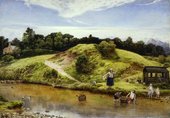
Fig.1
William Dyce
A Scene in Arran 1858–9
Aberdeen Picture gallery and Museums, Aberdeen
Notwithstandin, Tennyson's reference to the 'Terrible Muses' comes in a verse form published much later than the painting, the 'Mount Parnassus' of 1889. 'Capital of Delaware Beach', too, is after, with a publication date of 1867. None of the expo reviewers of 1860 establish Pegwell Bay bleak or melancholy, and none of them mentioned fossils. There is no evidence that Dyce himself suffered any loss of faith at some time in his life, whether because of scientific discoveries Beaver State for any other reason. Even if he had done and so, would he really have chosen to depict a family beach vacation, with portraits of his wife, child and sisters-in-law, as the setting for an formulation of religious doubt? The painting was sold-out to his Father of the Church-in-law, James Brand. Brand bought at least nine paintings from Dyce: four of them were of religious subjects. One of the other three landscapes bought aside Brand, A Scene in Arran (common fig.1), was a comparable scene to Pegwell Embayment, since it was produced as the result of a family holiday.5 A Scene in Arran was actually authorized aside Brand, and information technology has been suggested that the four children therein painting were portraits of Dyce's children.6
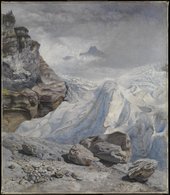
Fig.2
Saint John Brett
The Glacier of Rosenlaui 1856
Allen Tate N05643
Pic © Tate
Many artists were concerned in geology and astronomy in the 1850s and 1860s, although information technology was funny for a painting to blend them. Ii geologic paintings which have a close relationship with Dyce's painting are John Brett's The Glacier of Rosenlaui 1856 (Tate N05643; fig.2) and Charles John Napier Hemy's Among the Shake at Clovelly 1864 (fig.3). Both artists had rugged religious beliefs at the clip they painted their pictures. John Brett was later to fall back his religion, but in 1856 helium was a devout Christian who wrote in his diary of his fellow artist Saint John the Apostle William Inchbold: 'his whole nature is exquisitely tuned Christ living in him very manifestly'.7 Dyce could give birth seen The Glacier of Rosenlaui at the 1857 exhibition at the Royal Academy, London. Charles Napier Hemy was a Roman Catholic WHO had spent time as a Dominican Monk in the early 1860s, and when he died atomic number 2 chose to be interred in his Dominican robes.8 The pebble-strewn beach in his painting of Clovelly was very probably inspired by Dyce's Pegwell True laurel, only Hemy took the minute elaboration of the pebbles even further, fondly exploring the contrasts in form and the shaping effects of clean and colour. The fourth bulk of Ruskin's Modern Painters, subtitled 'Of Wads Beauty' and published in 1856, has many passages extolling the beauty of rocks and attributing their distribution to Divine Providence, which encouraged devout artists like these two to take up the study of geology.
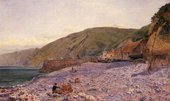
Figure.3
Charles Napier Hemy
Among the Shake at Clovelly 1864
Laing Artwork Gallery (Tyne and Wear Museums), Newcastle
Equally, astronomy could cost seen in this period equally supporting rather than undermining Christian feeling. One artist who was in particular interested in the night pitch was Samuel Palmer, and he painted a watercolor of a landscape with Donati's comet in the sky, which was exhibited at the Society of Painters in Watercolour in 1859, where Dyce might well have seen it. Entitled The Comet of 1858, as Seen from the Heights of Dartmoor 1858–9 (fig.4), it includes a group of figures, with a woman holding her baby up and pointing towards the comet – a possible source for the figure of the artist gazing at the comet in Pegwell Bay. Palmer was a devout creative person, who retained a strong Christian organized religion passim his life. Art historian William Vaughan has suggested that Palmer may have been influenced aside the sermons connected astronomy published in 1817 past Thomas Chalmers, the well-known Scottish churchman. Chalmers argued that the study of astronomy should tone our notion in Divinity by rearing the mind above earthly things:
there is such in the scene of a nocturnal sky, to lift the soul to self-righteous contemplation. That moon, and these stars, what are they? They are isolated from the world, and they bring up America in a higher place it. We feel withdrawn from the solid ground, and rise in lofty abstraction from this little theater of human passions and human anxieties. The mind abandons itself to reverie, and is transferred in the ecstasy of its thoughts, to faraway and unexplored regions. It sees nature in the simplicity of her great elements, and IT sees the Graven image of nature invested with the high attributes of sapience and majesty.9
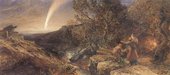
Fig.4
Samuel Palmer
The Comet of 1858, every bit Seen from the Heights of Dartmoor 1858–9
Private assemblage
Dyce would have noted Chalmers when he was living in Edinburgh in the early 1830s. Both were Fellows of the Royal Society of Edinburgh, Dyce existence elected in 1832 and Chalmers in 1834. The attitude of the artist pausing to look up at the comet in Pegwell Bay is not inharmonious with Chalmers's common sense of marvel at the 'loftiness' of the 'God of nature'.
To those who felt secure in their religion, the vastness of blank was an indication not of the empty of homo life, but of the large power and majesty of God. In a discourse published anonymously in 1858, the trajectory of Donati's comet prompted a meditation on the brevity of life on dry land and the Christian promise of the immortality of the soul:
We, like the comet, are present but for a short metre. We live upon our earth, only to pass onward to another scene; just when once we have passed onward, we ne'er more return, nor die a second time … We know where we shall be in the long unending future which we shall have entered ere this wandering star returns.10
There is none evidence that Dyce knew this particular sermon, but it is almost certain that he would feature read some other, mistakable textual matter on the comet. This was a letter to the Times, which was republished in 1858 in the English Cleric, a newspaper that Dyce is known to have read. The author, Vivian Webber, emphasises the compatibility of astronomy with religion:
For sure the contemplation of much a magnificent subject as astronomy tends to spiritualize and elevate us … flat the vast spaces we have been considering are as nothing in the eyes of Him to whom 'a thousand years are but as yesterday'. What glorious scenes lie beyond this immensity: there is to be found the very abode where Divinity has chosen to display Himself in the most magnificent manner! … Every bit magnificent truths are to be gleaned from the starry firmament A from the earth below.11
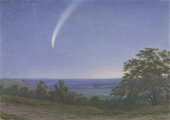
Seen in this light, the comet was a sight to arouse wonder and devotion. According to the art historian Roberta Olson and the astronomer Jay Pasachoff, Donati's comet was 'perfectly captivating', and one of the most beautiful ever recorded.12 It was first black-and-white by Giovanni Battista Donati, using a telescope, along 2 June 1858. By 19 Honorable it was seeable to the bare eye, and remained so until 4 December. Its celebrity derives in large role from its wonderfully broad, sweeping empennage, as well as from two less ofttimes seen thinner white tie.13 The comet was at its brightest on 5 Oct 1858, when it passed ahead of the bright stellar Arcturus. On this night it appeared at sunset, about 5.30 pm, and remained available until it Seth, the fountainhead at about 9 pm, the tail hours later. William Frederick Jackson Turner of Oxford exhibited a watercolour and gouache turn, entitled Donati's Comet, Oxford University, 7:30 p.m., 5 Oct. 1858 1858–9 (FIG.5), at the Companionship of Painters in Water-Colors in 1859. Information technology may well have been this water-color that gave Dyce the idea for Pegwell Bay, or if the picture was already low-level way, IT may own suggested his title, with its peculiar reference to location and date.
Libyan Islamic Grou.5
William Turner of Oxford
Donati's Comet, Oxford, 7:30pm, 5 Oct. 1858 1858–9
Yale Center for British Art, Raw Haven
The comet appears much larger and brighter in Turner's painting than it does in Dyce's painting. Similarly, Samuel Palmer's watercolour, also shown in the 1859 exhibition, depicts a large and brighter comet. Indeed, Roberta Olson and Jay Pasachoff have suggested that Dyce deliberately made the comet look smaller than it really appeared in nature: his portrayal is smaller than other representations of it from the time.14 According to a report in the Illustrated London News, the tail of the comet was upwards of 32 degrees in length, longer than the 25 degrees of the Smashing Comet of 1811, so that 'we have seen during the past few months a comet the largest, if not the brightest, visible within the memory of man'.15 On the new hand, Dyce does seem to be surgical in his placement of the comet in the western part of the sky: the same report says that 'the tail of the comet was very bright and medium-large from Oct. 3 to Oct. 11, and conferred a magnificent aspect in the western sandwich heavens during this interval'. The watercolours by Turner and Palmer represent the comet as an exciting, dazzling spectacle. Past contrast, Dyce's reference to the comet is extremely subtle, and one wonders whether the critics would possess noticed it at all if it had not been clearly signalled in his title of respect.
When Dyce died in February 1864, published obituaries stressed his devotion to the Anglican Church. The Morning Post declared that 'he used his great powers for religious purposes, and the Church service owes him a large debt of gratitude for his persistent devotion of his talents to her service'.16 The Illustrated Jack London News was more specific happening this target:
He was, as far arsenic we are reminiscent, the only when painter, with the exception of Mr. Victor Herbert, familiar with the writings of 'the Fathers'. In serve to Mr. John Ruskin's crude paradoxes on Church civil order in the pamphlet entitled 'The Construction of Sheepfolds', he wrote the able and energetic 'Shepherds and Sheep'.17
Indeed, Dyce devoted a substantial proportion of his sentence to church matters. He founded the Mottet Bon ton and wrote four articles on church music in 1841; in 1844 he publicized an edition of the Book of Common Prayer with its ancient Canto Fermo (plainchant). He wrote numerous articles and letters to newspapers about matters of church ritual and Christian observance. He was pally with many of the senior figures in the nineteenth-century church, especially those happening the Commanding Protestant denomination/Romanist Catholic wing, including John Henry Newman, Saint Nicholas Wiseman, Edward Bouverie Pusey and John Keble. An indicant of Dyce's cognitive state at the end of 1859, and presumably afterward he had painted Pegwell Bay, is seen in a long letter published in the European country Ecclesiastic on 15 Dec 1859. Here Dyce argued that true respect to the law of the Sabbath 'does not stand out in the observance of days or weeks or years, but in the unending rest into which those World Health Organization believe have entered (Heb.IV.3) and which is unbroken not aside abstaining from servile works, but by ceasing from sin'.18 It is likely that he was at least as troubled by conflicts within the church as by the conflict brewing betwixt skill and religion.
There May glucinium other allusions in Pegwell Bay than the ones that straightaway happen to twenty-first century observers. Art historiographer Malcolm Charles Dudley Warner has fusiform out that St Augustine landed stingy Pegwell Bay on his mission to convert the English to Christianity in 497 AD. Dyce would birth known this consequence well, since he had multi-colour a mural of Saint Augustine baptising King Ethelbert of Kent.19 The comet, therefore, may be an echo of the star of Bethlehem, which led the three Magi to Savior. The son standing on the abut of the shore, and sounding tabu to sea, apparently lost in thought, might have been suggested to Dyce by the story of Sir Isaac Newton's description of himself As being 'wish a male child acting connected the seashore, and diverting myself in like a sho and then finding a smoother pebble or a prettier shell than ordinary, while the great ocean of true statement lay out all undiscovered before me'. This anecdote was included in Sir David Brewster's life history of Newton, which had fresh been republished.20 Brewster was a prominent figure in knowledge base circles in Edinburgh, and Dyce, WHO had many family connections with scientists, would have known him.21 The anecdote was so well known that Dante Alighieri Gabriel Rossetti had been asked in 1855 to instance it for a mural in the new University Museum of Innate Story in Oxford.22
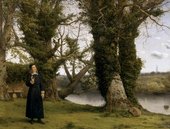
Fig.6
William Dyce
George I Herbert at Bemerton c.1860
Guildhall Art Gallery, Corp of London
Pegwell Bay was accompanied by two pictures of traditional Christian subjects at the Royal Academy exhibition of 1860. In the following year, 1861, Dyce exhibited a painting entitled George Herbert at Bemerton of c.1860 (Ficus carica.6). This clock he ready-made the meaning of the painting vindicated by inserting the front verse of a poem by Herbert in the Royal Academy catalog, next to the claim of his painting:
Loveable day, and so cool, and then calm, so agleam!
The marriage ceremony of the earth and sky –
The dew shall cry thy shine tonight:
For thou must die.23
This verse form has iv verses: the middle two lament that the rose and the spring, overly, must die. Yet the verse form ends on a positive note by affirming belief in the immortality of the soul:
Solely a sweet and virtuous soul,
Like season'd timber, never gives;
Merely though the undivided world turn to coal,
Then chiefly lives.
The picture was a nonclassical and critical success. One referee recommended that there was a take aim connection between Dyce's minute finishing and his pious subject:
The ALT of the subject, the pure devout opinion embodied, would seem to demand nothing less than the about absolute truth in the minutest item. In such a picture the tricks and shams of convention would be out of place, rather at variance with the pure holy feeling with which the work is inspired.24
Seen in this light, the hyperreal clarity and item in Pegwell Quest mightiness also represent seen as visionary, an effect of heightened awareness brought on by the dish of the natural international, enhanced by religious faith.
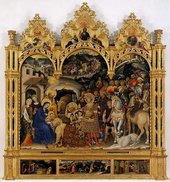
Fig.7
Gentile da Fabriano
The Adoration of the Magi 1423
Uffizi Art gallery, Firenze
The question remains as to whether we go can further and tell that Pegwell Quest is a religious painting. Dyce would have noted that European country Renascence artists delineated the star of Bethlehem as a comet, and he would also feature legendary paintings in which combined or Thomas More figures observe a supernatural case while other figures in the house painting remain oblivious to it.25 A peculiar compositional root could be Gentile da Fabriano's Latria of the Magi 1423, now in the Uffizi Gallery, Florence (fig.7). Therein house painting, the three Magi are shown in the backclot, observing the star/comet in the sky, exactly as Dyce himself observes Donati's comet in his house painting. They are shown again in the foreground. Dyce's three women, with their contrasting positions from standing to kneeling and their bulky article of clothing, echo the locating of Gentile's three Magi. Caves occur both in paintings of Christ's nativity and in depictions of his entombment; the three Magi who came presently after his parentage are echoed in the three Marys who tended to his tomb. Even the donkeys could be seen to refer to the aliveness of Saviour and his entry into Jerusalem. The combination of the comet in the toss and the caves in the cliffs may therefore be a reference non to the late ordinal-century concept of the 'Alarming Muses' of astronomy and geology, merely to the much older tradition of Christian iconography, produced by an artist who had a thorough knowledge of both Renascence picture and the Bible.
If Pegwell Bay is so a disguised religious house painting, this would bring it closer to other Pre-Raphaelite modern sprightliness scenes, such as John Everett Sir John Everett Millais's The Blind Girl 1856 (Birmingham Museum and Art Gallery, Birmingham) and Whoremaster Brett's Stonebreaker 1857–8 (Walker Art Gallery, Liverpool), in which Christian symbols appear As natural elements in the landscape.26 IT might be seen A a meditation happening nascence, death and resurrection, in an appropriate setting since the seashore was often regarded as the nonliteral boundary between life and death. In the background, Dyce looks up at the comet, fixing his heart on heavenly things. In the foreground, his wife and child look uneasily towards a future without him, only the presence of the two sisters is a reassurance that the wider family unit will support them. Whether the painting is about faith OR dubiousness (and it could be argued that one implies the other), it is understandably much Sir Thomas More than a literal transcript of an October Day on the slide. Neither the comet nor the chalk cliffs appear to have been accurately written, and perhaps this was even moot on Dyce's divide. Contempt the 'scientific' coming into court of the painting, Dyce's writings in the 1850s are much more implicated with religion than with skill, arsenic he made clean-handed in an unsmooth letter found among his papers, dating to 1857:
What masses in this country have to learn is that the science of the Beaux arts is not Physical Science, but the science of the Beautiful; and that information technology belongs to the region of Ethics non of Physics.27
what do science art and religion have in common
Source: https://www.tate.org.uk/research/publications/in-focus/pegwell-bay-kent-william-dyce/art-science-religion

Posting Komentar untuk "what do science art and religion have in common"